Staff accounts
Employees and contractors whose logins or sessions turned up in the data.
 Ashetrace
THREAT INTELLIGENCE PLATFORM
Ashetrace is a B2B threat-intelligence platform. We monitor the dark web, credential markets and infostealer networks for your verified domains, name the actors behind what we find, and turn every hit into a case with an owner.
Aggregate preview only · no login, nothing stored.
We watch the places corporate data ends up — breach dumps, infostealer log networks, criminal forums, Telegram channels and leak sites — and match what surfaces against the domains you have verified. When something of yours appears, you get what it is, who is behind it, and what to do about it.
Four things run continuously against your domains:
Dark web monitoringCriminal forums, Telegram channels, leak sites and access markets, watched for your company by name, domain and brand.
Leaked credentials and infostealer logsBillions of records from breach dumps and stealer-log networks, matched to the people in your organisation.
Threat actorsWho is selling or using it: aliases, tooling, the channels they operate in, and whether they have touched your assets before.
Cases and monitorsEvery finding becomes a case with an owner, and the monitors keep running so the next one reaches you the day it surfaces.
credential records indexed
Some of them are your company's.
Breach compilations, infostealer logs and combolists in one corpus, matched against your verified domains in seconds and growing with every release.
Employees and contractors whose logins or sessions turned up in the data.
Admin, finance and production access — the ones that go to the front of the queue.
Which machines were infected, including personal laptops and ones IT does not manage.
The cookies that keep someone signed in to your sites and systems after the password changes.
Access to your cloud accounts, code repositories and VPN.
Outside companies whose people log into your systems.
On the left, the queue: every exposure tied to your domains, ordered by what can still reach the business, each one with an owner. On the right, the group behind it — where the data surfaced, when we collected it, and which of your assets they have already touched. That is the case your team works, and the record that proves it was closed.
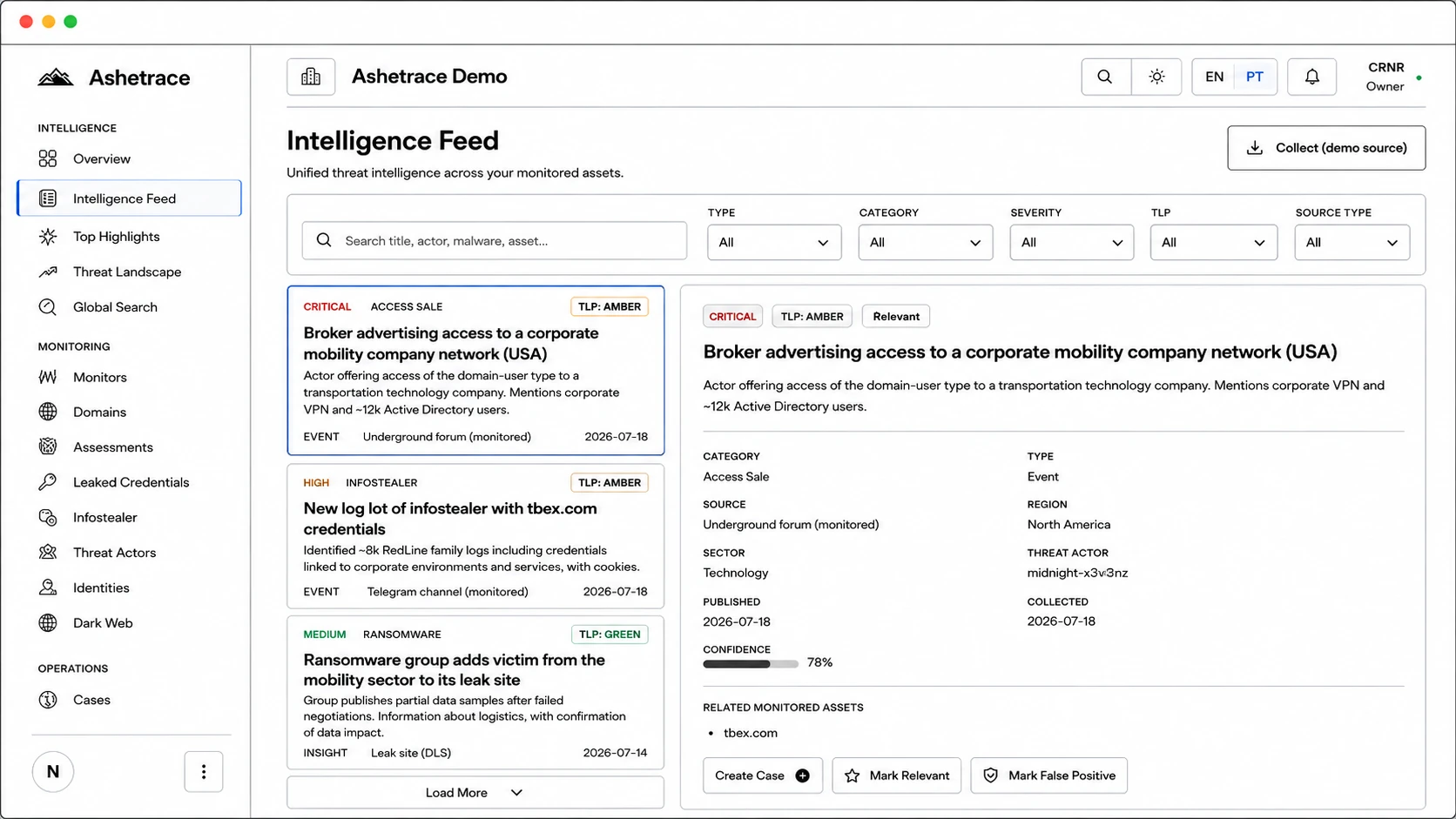
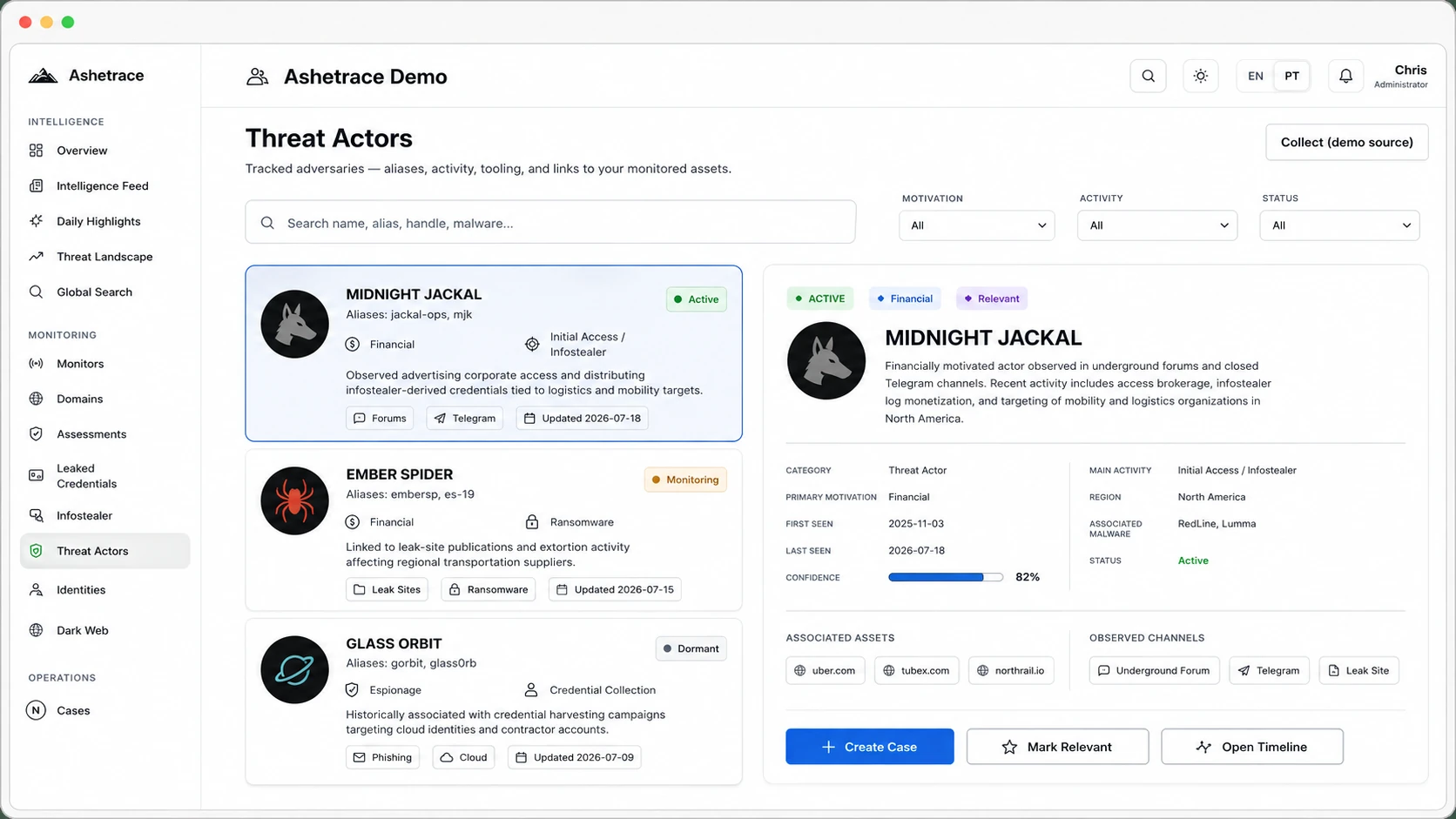
Signals from infostealer and breach data become reviewable cases, assigned to the people who can contain them.
Infostealer and breach intelligence is gathered from authorised sources only.
Records are deduplicated and indexed for lookup, with reusable secrets stripped at ingest.
Exposure for a verified corporate domain becomes reviewable, assignable cases.
Find an exposed employee, supplier or service account in a verified domain.
Assign the identity to the person or team responsible for the access.
Check privilege, reachable applications, sessions and evidence recency.
Reset access, revoke sessions and start endpoint or vendor action.
Keep the action record and evidence required to prove containment.
We add exposure context to the systems your team already owns, rather than replace the identity provider, SIEM or ticketing queue. These are the connections we are building.
On our integration roadmap
so a stolen session can be revoked and the account handed back to you
so the exposure lands in the queue your analysts already watch
so the case becomes a ticket you can follow to closure
We confirm whether the account still opens, then close every session already running on it.
The token is revoked at your identity provider, and we check which applications it was opening.
It goes up the chain first: rotate the secrets it holds and read back the audit trail.
We take it to the supplier, then you decide whether that access stays.
The device is dealt with, and we watch it so the same laptop does not reinfect you next month.
Search engines hand you raw data. Alerting tools hand you a notification. We hand each exposure to an owner and follow it to proven containment. The table compares approaches, not vendors.
Built in · Partial or manual · Not the tool’s job
We limit assessment to the corporate domains you have verified, and every case is owned, isolated by tenant and logged.
The exposed credentials are your company's, so your team sees what it needs to act on them. What we do not hand over is anything outside the domains you verified.
Assessments are restricted to corporate domains your organisation has verified.
Separate tenant boundaries, audit trails and role-based access keep cases owned.
Cases guide validation, containment and documented closure for the organisation.
Verify a corporate domain and receive a scoped exposure assessment with no passwords, cookies or tokens handed over.
Every day an exposed session stays valid is another day of access to your environment.
Ashetrace is a B2B threat-intelligence platform for infostealer exposure response. It matches a company's verified domains against a corpus of breach compilations, infostealer stealer-logs and combolists, then turns each hit into a reviewable case with the affected identity, the exposure type (credential, session, device, cloud or supplier) and a recommended containment action. The goal is not another leak feed but a defensible response workflow: an owner for every exposure, evidence without reusable secrets, and a record that proves the case was contained. It is built for the teams responsible for that response, including SOC, incident response, IAM and MSSP.
Dark web monitoring tells you that a credential appeared somewhere and sends an alert. Ashetrace starts where that alert ends. It scopes exposure to domains your organisation has verified, classifies each hit by what an attacker can still do with it (is the session live, was the token stolen, is the account privileged), assigns the case to an owner, and follows it to documented containment. The difference is workflow and context: a notification versus an assignable, evidence-backed case that separates identity, session, device, cloud and supplier exposure so your team applies the right action instead of resetting a password and hoping.
Because an infostealer takes more than the password. It commonly exfiltrates active session cookies and refresh tokens, which stay valid after a reset and can bypass MFA, plus evidence of the infected device and any cloud or code credentials stored in the browser. Resetting the password closes one door while the stolen session, the unmanaged device and any privileged or third-party access remain open. Ashetrace separates each of those exposure layers so the response covers session revocation, device action and access review, not just a credential change.
No. Ashetrace classifies and masks sensitive artifacts by default. A case shows the context a responder needs to remediate, such as the affected identity, the exposure type and the source provenance, without handing over reusable access. The platform is deliberately not a repository of live secrets: it assesses verified corporate domains only, keeps reusable credentials out of the case view, and maintains an append-only audit trail so every action stays accountable. That keeps the workflow defensive and avoids creating a second store of the very data you are trying to contain.
A corporate domain your organisation controls and a contact from the company. Ashetrace verifies the domain before assessing it and scopes the assessment to assets the organisation owns, not shared mailboxes or public webmail. No passwords, cookies or tokens are ever requested from you. The output is a scoped exposure assessment: the affected identities on that domain, the exposure types, and the cases that still carry business risk, ready to assign and contain. Verified-domain scoping is what keeps the assessment lawful, relevant and free of noise from data your organisation does not own.
Ashetrace draws on a corpus of billions of credential records assembled from breach compilations, infostealer stealer-log networks and combolists, collected from authorised sources and refreshed as new releases appear. Records are deduplicated and indexed for lookup, with reusable secrets stripped at ingest. A match against a verified domain becomes a case tagged with its source provenance, so a responder can see where the exposure came from and how recent it is. Because infostealer logs surface daily, a clean assessment is a point-in-time result, which is why exposure is best treated as a monitored, ongoing surface rather than a one-off check.
Yes. Ashetrace is multi-tenant by design. Strict tenant isolation, delegated access and per-case ownership let a managed security service provider operate on behalf of several verified clients without mixing their data. Each client's exposure stays scoped to the domains that client has verified, cases are assigned and tracked per tenant, and an append-only audit trail records who did what. That lets an MSSP run exposure response as a service, with the boundaries, accountability and reporting that both the provider and the end client need.